Sometimes I wonder what to say in my blog posts. It often feels as if I don't really have anything new -- God is awesome, I'm in love with Lana, school is school, Hunted is still going, church is good . . . ahem, uh, new stuff, please?
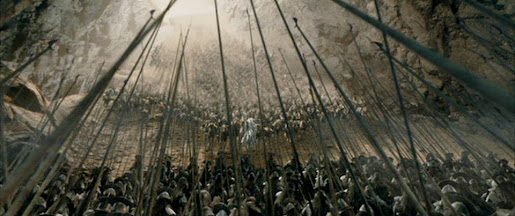
It's an issue for me as an artist, too, because as Solomon so aptly put it, "There is nothing new under the sun." I recently saw the first forty minutes of The Matrix in my theater class. The story of that wildly popular film has been touted as fresh, outside-the-box, mindblowing -- but its world-that's-not-real concept dates back to ancient Greek philosophy. Even J. R. R. Tolkien's The Lord of the Rings, one of the most powerfully original and inventive masterpieces the English language has ever seen, uses a variety of plot points that date back for centuries.
But maybe what matters is not the originality of the content as much as how it's presented. George Lucas' Star Wars used archetypes as old as storytelling itself -- the young dreamer with high destiny (Luke Skywalker), the old man serving as mentor (Obi-Wan Kenobi), the damsel in distress (Princess Leia), the rogue adventurer (Han Solo), the ruthless villain (Darth Vader), etc. But it reframed those character types, often putting a new spin on them, in a story that came off as completely fresh and memorable.
So back to me: I seek to tell stories. Great stories, bold stories, revolutionary stories that impact the reader and point to Christ. But I've gotta be realistic. I know there's only so many ways I can portray my hero (or whatever character), and most of them have been done before, many times. But whether I use one of the old methods or try to spin up something new on my own, I'm seeking a unique portrayal, and one that's my own.
And to me, that's the key. Does the fact that my story may not be that original after all make me want to toss up my hands and just start stealing ideas? No, it really makes me want to work harder to achieve a high level of storytelling. My story won't have any revolutionary themes, but I can frame those themes in a way that no one has ever done before.
The very idea of doing that strikes a chord in me. I don't know if you writers out there feel it too, but it cuts to the heart of what I want to be as an artist. I want to tell fresh, exciting stories that bring a smile to my Creator's face and point people to Him. And I pray that the very first person who gets pointed to God through my stories will be their author.
Ultimately, the reason none of our stories will ever be really new is that God has already created all. He is the Master of all storytelling, and all of our tales are ultimately derived from his epic True Myth. What is the True Myth, you ask? Well, it's a phrase coined by Tolkien (when he was witnessing to an atheist friend named C. S. Lewis, incidentally) to describe the Gospel story of Christ. I would stretch it to include the entire story of God's redemption of man, which means that it's everything that's ever happened and ever will happen. It truly is your story and my story, in addition to being Adam's story, and Noah's story, and Peter's and Paul's and Martin Luther's and Mother Teresa's and Billy Graham's. We are all a vital part of His story.
So when we seek to tell our own made-up stories, the beautiful word that describes it is subcreation. I, the man, seek to tell my tales and craft my art, but it is ultimately derived from and subordinate to my Heavenly Father and the Story that He continues to unfold.
I love being a subcreator under You the ultimate Creator, Father. Praise You for the gift of story You have given to mankind. May we use it for Your glory.
Showing posts with label subcreation. Show all posts
Showing posts with label subcreation. Show all posts
Tuesday, October 2, 2007


Subscribe to:
Posts (Atom)
Forth Eorlingas